
The Colors of IC 1795
This colorful cosmic portrait features glowing gas and obscuring dust clouds in IC 1795, a star forming region in the northern constellation Cassiopeia. The nebula's colors were created by adopting the Hubble false-color palette for mapping ...

HUDF Infrared: Dawn of the Galaxies
When did galaxies form? To help find out, the deepest near-infrared image of the sky ever has been taken of the same field as the optical-light Hubble Ultra Deep Field (HUDF) in 2004. The new image was taken this summer by the newly installed ...

Ice Moon Tethys from Saturn-Orbiting...
What processes formed the unusual surface of Saturn's moon Tethys? To help find out, NASA sent the robotic Cassini spacecraft right past the enigmatic ice moon in 2005. Pictured above is one of the highest resolution images of an entire face of ...

The International Space Station Over...
This was home. Just over a week ago, the STS-129 crew of the Space Shuttle Atlantis undocked from the International Space Station (ISS) and returned to Earth. As the shuttle departed the space station, they took the above image. Visible on ...

The Magnificent Tail of Comet McNaught
Comet McNaught, the Great Comet of 2007, was the brightest comet of the last 40 years. Its spectacular tail spread across the sky and was breathtaking to behold from dark locations for many Southern Hemisphere observers. The head of the comet ...

Himalayan Skyscape
Capella, alpha star of the constellation Auriga, rises over Mt. Everest in this panoramic view of the top of the world at night. The scene was recorded in late November near Namche Bazar, Nepal, gateway to the Himalayan mountain range. Moonlight ...

The Double Cluster
A lovely starfield in the heroic northern constellation Perseus holds this famous pair of open or galactic star clusters, h and Chi Persei. Also cataloged as NGC 869 (right) and NGC 884, both clusters are about 7,000 light-years away and contain ...

Polar Ring Galaxy NGC 660
NGC 660 lies near the center of this intriguing field of galaxies swimming within the boundaries of the constellation Pisces. Over 20 million light-years away, its peculiar appearance marks it as a polar ring galaxy. A rare galaxy type, polar ...
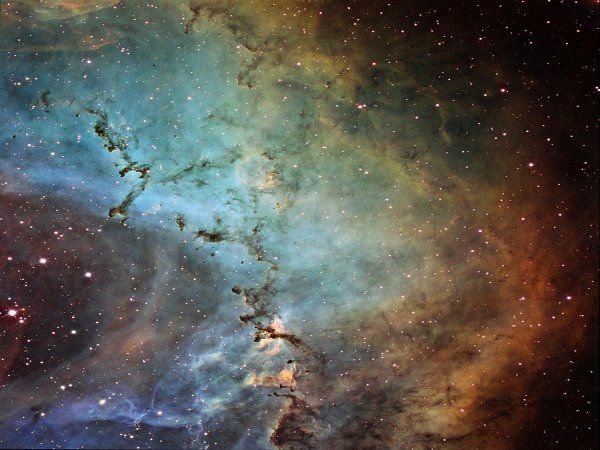
Dust Sculptures in the Rosette Nebula
What creates the cosmic dust sculptures in the Rosette Nebula? Noted for the common beauty of its overall shape, parts of the Rosette Nebula, also known as NGC 2237, show beauty even when viewed up close. Visible above are globules of dark dust ...
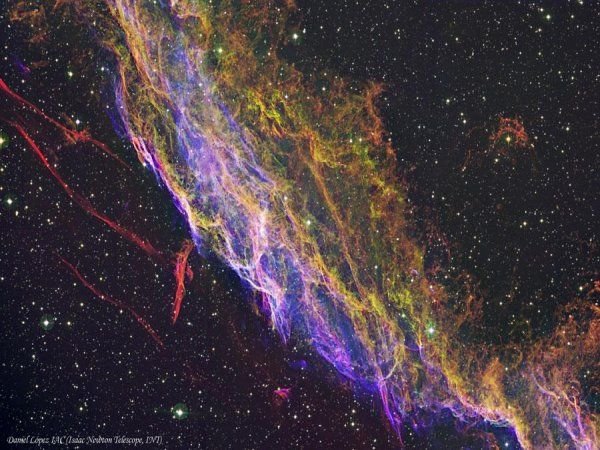
NGC 6992: Filaments of the Veil Nebula
Wisps like this are all that remain visible of a Milky Way star. About 7,500 years ago that star exploded in a supernova leaving the Veil Nebula, also known as the Cygnus Loop. At the time, the expanding cloud was likely as bright as a crescent ...
ISS
Buy us a coffee!

