
NGC 4676: When Mice Collide
These two mighty galaxies are pulling each other apart. Known as "The Mice" because they have such long tails, each spiral galaxy has likely already passed through the other. They will probably collide again and again until they coalesce. The ...

Dark Markings of the Sky
Based on wide field photographs, American astronomer Edward Emerson Barnard cataloged the dark markings of the sky in the early 20th century. Barnard's markings are dark nebulae, interstellar clouds of obscuring gas and dust. Their shapes are ...

Moon and Morning Star
Wednesday, the Moon and Venus rose together in early morning skies. Even through clouds, both show off a lovely crescent in this well-composed skyscape from Rutherford College, North Carolina, in the eastern US. Farther west, North American ...

Sky Panorama Over Lake Salda
As midnight approached, a spectacular sky appeared. Such was the case last month from the shore of Lake Salda in southwestern Turkey. In the above night sky panorama, rocky sand covers the foreground, while building lights are visible across ...

Global Warming Predictions
How much will the Earth's surface warm up over the lives of our children? No one is sure. Compared to the past 100 million years, the Earth is currently enduring a relative cold spell, possibly about four degrees Celsius below average. Over the ...
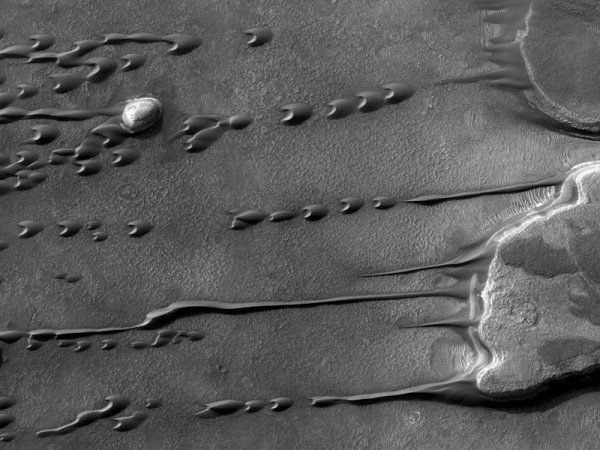
Flowing Barchan Sand Dunes on Mars
When does Mars act like a liquid? Although liquids freeze and evaporate quickly into the thin atmosphere of Mars, persistent winds may make large sand dunes appear to flow and even drip like a liquid. Visible on the above image right are two ...

The View Near a Black Hole
In the center of a swirling whirlpool of hot gas is likely a beast that has never been seen directly: a black hole. Studies of the bright light emitted by the swirling gas frequently indicate not only that a black hole is present, but also ...

NGC 1333 Stardust
NGC 1333 is seen in visible light as a reflection nebula, dominated by bluish hues characteristic of starlight reflected by dust. A mere 1,000 light-years distant toward the heroic constellation Perseus, it lies at the edge of a large, ...

Medieval Astronomy from Melk Abbey
Discovered by accident, this manuscript page provides graphical insight to astronomy in medieval times, before the Renaissance and the influence of Nicolaus Copernicus, Tycho de Brahe, Johannes Kepler, and Galileo. The intriguing page is from ...

Castle and Full Moon
Clouds couldn't hide this bright Full Moon as it rose last week over the medieval castle of Tourrette-Levens near Nice, France. Exactly full on April 9 at 1456 UT, it followed the March equinox, making it the first Full Moon of spring in the ...
ISS
Buy us a coffee!


