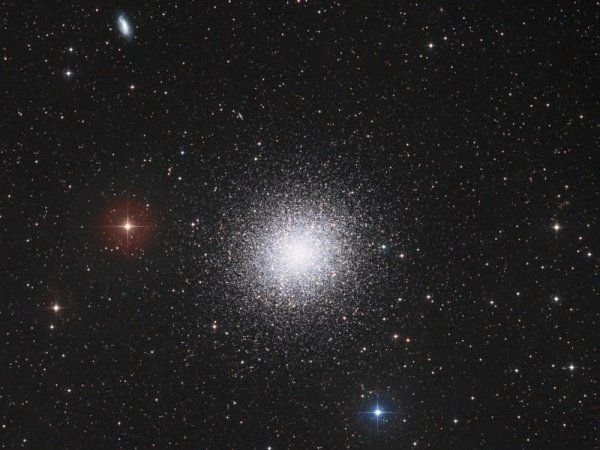
M13: The Great Globular Cluster in...
M13 is modestly recognized as the Great Globular Cluster in Hercules. A system of stars numbering in the hundreds of thousands, it is one of the brightest globular star clusters in the northern sky. At a distance of 25,000 light-years, the ...

Tunguska: The Largest Recent Impact...
Yes, but can your meteor do this? The most powerful natural explosion in recent Earth history occurred on 1908 June 30 when a meteor exploded above the Tunguska River in Siberia, Russia. Detonating with an estimated power 1,000 times greater ...

The Inner Coma of Comet Holmes
What's happening to Comet Holmes? The rare comet remains visible to the unaided eyes of northern observers as an unusual small puff ball in the constellation of Perseus. A high resolution set of images of the comet's inner coma, taken last week ...

Cosmic Rays from Galactic Centers
Where do cosmic rays come from? A major step toward answering this century old question may have just come in from the Auger Observatory project, the world's premier cosmic ray observatory. That high energy fundamental particles are barreling ...

NGC 6888: The Crescent Nebula
What caused the Crescent Nebula? Looking like an emerging space cocoon, the Crescent Nebula, visible in the center of the above image, was created by the brightest star in its center. A leading progenitor hypothesis has the Crescent Nebula ...

A Tale of Comet Holmes
A beautiful blue ion tail has become visible in deep telescopic images of Comet Holmes. Pointing generally away from the Sun and also planet Earth, the comet's ion tail is seriously foreshortened by our extreme viewing angle. Still, enthusiastic ...

Skyscape with Comet Holmes
This gorgeous skyscape spans some 10 degrees across the heroic constellation Perseus, about the size of a generous binocular field of view. The deep exposure includes bright stars, emission nebulae, star clusters, and, of course, the famous Comet ...

VERITAS and Venus
rly morning risers and late to bed astronomers have recently enjoyed bright planets in predawn skies, with brilliant Venus above the eastern horizon. On November 5, Venus was joined by the waning crescent Moon. This self-portrait by astronomer ...

The Sloan Great Wall: Largest Known...
What is the largest structure known? The answer might depend on how one defines "structure." A grouping of galaxies known as the Sloan Great Wall was discovered in the Sloan Digital Sky Survey and is a leading candidate. The Sloan Great Wall can ...

An X Class Flare Region on the Sun
Why does the Sun flare? Unpredictably, our Sun unleashes tremendous flares expelling hot gas into the Solar System that can affect satellites, astronauts, and power grids on Earth. This close up of an active region on the Sun that produced a ...
ISS
Buy us a coffee!


