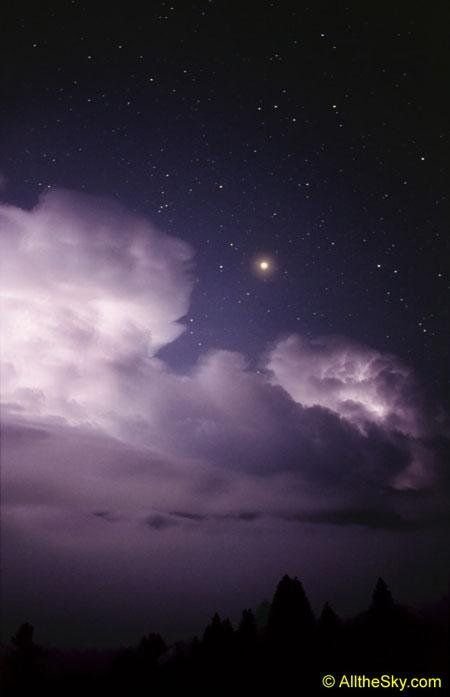
A Dark and Stormy Night
It was a dark and stormy night. But on 2003 August 29th the red planet Mars, near its closest approach to Earth in almost 60,000 years, shone brightly in the sky against a background of stars in the constellation Aquarius. In the foreground of ...

NGC 3242: The Ghost of Jupiter
After a star like the Sun completes fusion in its core, it throws off its outer layers in a brief, beautiful cosmic display called a planetary nebula. NGC 3242 is such a planetary nebula, with the stellar remnant white dwarf star visible at the ...

October Mars
This October, Mars has become a bright, yellowish star in planet Earth's sky as it approaches oppositon, the period when Mars and Earth pass close as they orbit the Sun. How close is Mars? A mere 70 million kilometers or so, close enough to allow ...

The Last Titan
On October 19th, a rocket blasted off from Vandenberg Air Force Base - the last Titan rocket. Carrying a payload for the US National Reconnaissance Office, the successful Titan IV B launch brings to a close the Titan program whose first launch ...

4,500 Kilometers Above Dione
What does the surface of Saturn's moon Dione look like? To find out, the robot Cassini spacecraft currently orbiting Saturn flew right past the fourth largest moon of the giant planet earlier this month. Pictured above is an image taken about ...

Supernova Remnant N132D in Optical...
Thousands of years after a star exploded, its expanding remnant still glows brightly across the spectrum. Such is the case with N132D, a supernova remnant located in the neighboring Large Magellanic Cloud (LMC) galaxy. The expanding shell from ...

Angular Sand on Martian Hills
Why isn't this sand round? The robotic Spirit rover currently rolling across Mars has found notably angular sand in the Columbia Hills on Mars. Previously, small bits of sand found in the plains of Gusev Crater were significantly more round. ...

At the Center of the Milky Way
At the center of our Milky Way Galaxy lies a black hole with over 2 million times the mass of the Sun. Once a controversial claim, this astounding conclusion is now virtually inescapable and based on observations of stars orbiting very near the ...

Ring Galaxy AM 0644-741 from Hubble
How could a galaxy become shaped like a ring? The rim of the blue galaxy pictured on the right is an immense ring-like structure 150,000 light years in diameter composed of newly formed, extremely bright, massive stars. That galaxy, AM 0644-741, ...

Ringside
Orbiting in the plane of Saturn's rings, Dione and the other icy saturnian moons have a perpetual ringside view of the gorgeous gas giant planet. Of course, while passing through the ring plane the Cassini spacecraft also shares their stunning ...
ISS
Buy us a coffee!

