
A Solar Filament Lifts Off
Hot gas frequently erupts from the Sun. One such eruption produced the glowing filament pictured above, which was captured in 2000 July by the Earth-orbiting TRACE satellite. The filament, although small compared to the overall size of the Sun, ...

A String Of Pearls
Comet Shoemaker-Levy 9, named after its co-discoverers, was often referred to as the "string of pearls" comet. It is famous for its suggestive appearance as well as its collision with the planet Jupiter! The comet's original single nucleus was ...
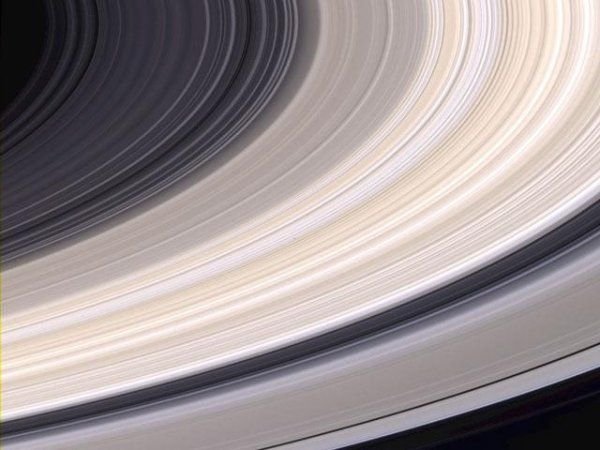
Saturn's Rings in Natural Color
What colors are Saturn's rings? Recent images from the Cassini spacecraft now orbiting Saturn confirm that different rings have slightly different colors. The above image shows their sometimes-subtle differences in brightness and color. The ...

Aura Launch
In this alluring time exposure, star trails arc across the night sky above Monterey Bay and the lights of Santa Cruz, California, USA. But since the exposure began around 3:01am PDT on July 15 it also records the long trail of a Delta II rocket ...

A Shadow on the Rings of Saturn
This picture of Saturn could not have been taken from Earth. No Earth based picture could possibly view the night side of Saturn and the corresponding shadow cast across Saturn's rings. Since Earth is much closer to the Sun than Saturn, only ...

Space Station, Venus, Sun
On June 8, Venus was not the only celestial object to pass in front of the Sun. A few well-situated photographers caught the International Space Station also crossing the Sun simultaneously. Pictured above is a unique time-lapse image of the ...

Attacking Mars
The Spirit rover attacked Mars again late last month. What might look, above, like a military attack, though, was once again just a scientific one - Spirit was instructed to closely inspect some interesting rocks near Columbia Hills. Spirits ...

M31: The Andromeda Galaxy
Andromeda is the nearest major galaxy to our own Milky Way Galaxy. Our Galaxy is thought to look much like Andromeda. Together these two galaxies dominate the Local Group of galaxies. The diffuse light from Andromeda is caused by the hundreds ...

Transit of Venus Stereogram
Venus glides in front of an enormous solar disk in these two frames from the TRACE satellite imaging of the inner planet's 2004 transit. Arranged in a "right/left" stereogram, the frames are intended to be viewed at a comfortable distance from ...

The Bubble
Blown by the wind from a star, this tantalizing, ghostly apparition is cataloged as NGC 7635, but known simply as The Bubble Nebula. Astronomer Ken Crawford's striking view combines a long exposure through a hydrogen alpha filter with color ...
ISS
Buy us a coffee!

