
Pleiades Deep Field
Have you ever seen the Pleiades star cluster? Even if you have, you probably have never seen it like this: all dusty. Perhaps the most famous star cluster on the sky, the bright stars of the Pleiades can be seen without binoculars from even the ...

Kepler-16b: A Planet with Two Suns
If you stay up long enough, you can watch both suns set. Such might be a common adage from beings floating in the atmosphere of Kepler 16b, a planet recently discovered by the space-based Kepler satellite. The above animated video shows how the ...

The South Pole of Asteroid Vesta
What created the circular structure around the south pole of asteroid Vesta? Pictured above, the bottom of the second largest object in the asteroid belt was recently imaged for the first time by the robotic Dawn satellite that arrived last ...

A Sharp View of the Sun
Here is one of the sharper views of the Sun ever taken. This stunning image shows remarkable details of a dark sunspot across the image bottom and numerous boiling granules which appear like kernels of corn across the top. Taken in 2002, the ...

Spitzer's Orion
Few cosmic vistas excite the imagination like the Orion Nebula, an immense stellar nursery some 1,500 light-years away. This stunning false-color view spans about 40 light-years across the region, constructed using infrared data from the Spitzer ...

September's Harvest Moon
A Full Moon rising can be a dramatic celestial sight, and Full Moons can have many names. For example, Monday's Full Moon was the one nearest this year's autumnal equinox for the northern hemisphere, traditionally called the Harvest Moon. ...

NGC 3521: Galaxy in a Bubble
Gorgeous spiral galaxy NGC 3521 is a mere 35 million light-years away, toward the constellation Leo. Relatively bright in planet Earth's sky, NGC 3521 is easily visible in small telescopes but often overlooked by amateur imagers in favor of other ...

The Bubble and M52
To the eye, this cosmic composition nicely balances the Bubble Nebula at the lower right with open star cluster M52. The pair would be lopsided on other scales, though. Embedded in a complex of interstellar dust and gas and blown by the winds ...

Great Orion Nebulae
The Great Nebula in Orion, also known as M42, is one of the most famous nebulas in the sky. The star forming region's glowing gas clouds and hot young stars are on the right in this sharp and colorful image that includes the smaller nebula M43 ...
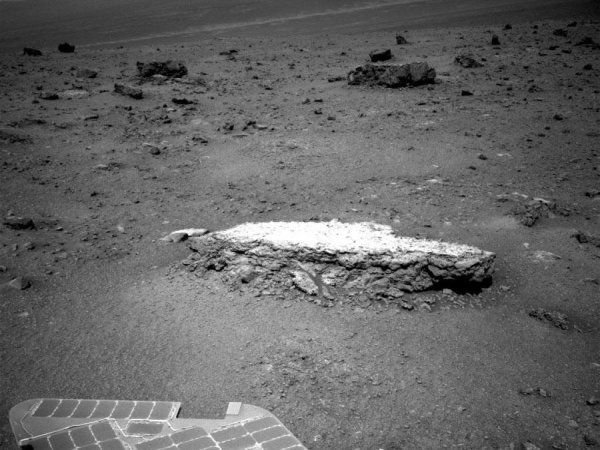
Tisdale 2 Rock Formation on Mars
Why does this Martian rock have so much zinc? Roughly the size and shape of a tilted coffee-table, this oddly flat, light-topped rock outcropping was chanced upon a few weeks ago by the robotic Opportunity rover currently rolling across Mars. ...
ISS
Buy us a coffee!

