
On the Origin of Gold
Where did the gold in your jewelry originate? No one is completely sure. The relative average abundance in our Solar System appears higher than can be made in the early universe, in stars, and even in typical supernova explosions. Some ...

Rollback from GRAIL's Rocket
This dramatic time-lapse photo traces a 20 minute long, late evening rollback of the lighted Mobile Service Tower at Cape Canaveral Air Force Station Launch Complex 17. Twin spacecraft are snug inside the 13 story tall Delta 2 rocket poised for ...

Comet Garradd and the Coat Hanger
Sweeping through planet Earth's night sky, last weekend Comet Garradd (C/2009 P1) visited this lovely star field along the Milky Way in the constellation Vulpecula. Suggestively oriented, the colorful skyscape features stars in the asterism known ...

Apollo 17 Site: A Sharper View
This view of the Apollo 17 landing site in the Taurus-Littrow valley was captured last month by the Lunar Reconnaissance Orbiter (LRO), the sharpest ever recorded from space. The high resolution image data was taken during a period when LRO's ...

SDSS J102915+172927: A Star That...
Why does this star have so few heavy elements? Stars born in the generation of our Sun have an expected abundance of elements heavier than hydrogen and helium mixed into their atmospheres. Stars born in the generation before our Sun, Population ...

M6: The Butterfly Cluster
To some, the outline of the open cluster of stars M6 resembles a butterfly. M6, also known as NGC 6405, spans about 20 light-years and lies about 2,000 light years distant. M6 can best be seen in a dark sky with binoculars towards the ...

HH 47: A Young Star Jet Expands
Stars remain where they are. Nebulas appear the same. Day after day. Year after year. Given the vast distances in astronomy, even fast moving objects will not appear to change their appearance in a human lifetime. Typically. A recent spectacular ...
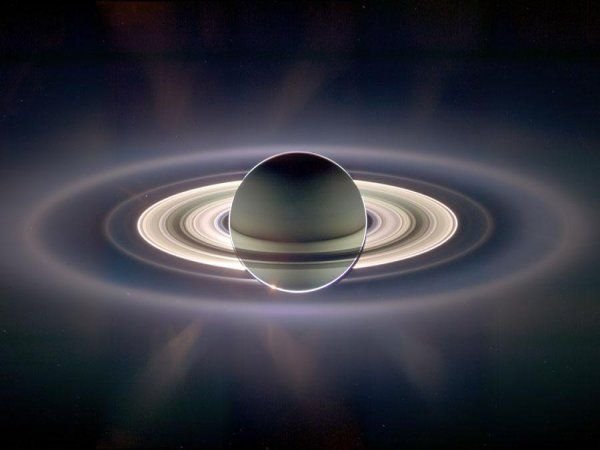
In the Shadow of Saturn
In the shadow of Saturn, unexpected wonders appear. The robotic Cassini spacecraft now orbiting Saturn drifted in giant planet's shadow for about 12 hours in 2006 and looked back toward the eclipsed Sun. Cassini saw a view unlike any other. ...

Comet Garradd Passes Ten Thousand Stars
Comet Garradd continues to brighten as it drifts across the northern sky. Last week the comet, visible with binoculars and discernible by its green coma, passed nearly in front of globular cluster M71. M71 was once thought to be an open cluster, ...
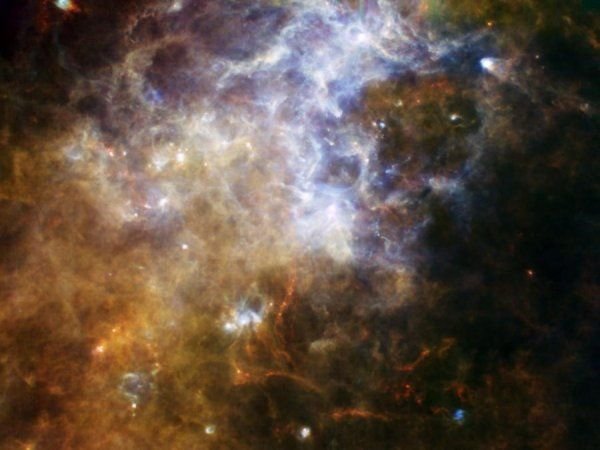
Herschel Views the Milky Way
With a 3.5 meter diameter mirror, larger than the Hubble Space Telescope, ESA's Herschel Space Observatory explores the Universe at infrared wavelengths. Herschel is named for German-born British astronomer Frederick William Herschel who ...
ISS
Buy us a coffee!

