
M72: A Globular Cluster of Stars
Globular clusters once ruled the Milky Way. Back in the old days, back when our Galaxy first formed, perhaps thousands of globular clusters roamed our Galaxy. Today, there are less than 200 left. Many globular clusters were destroyed over the ...
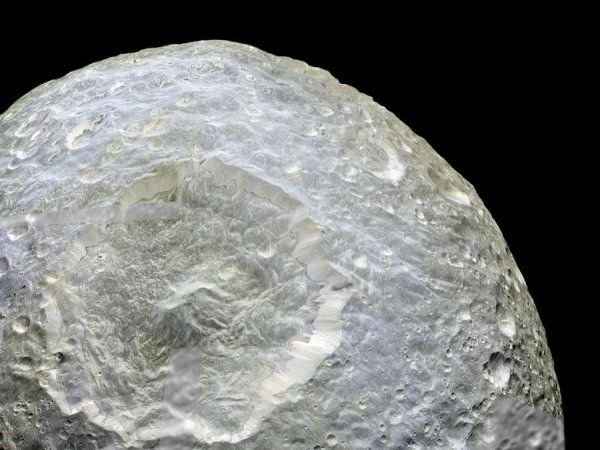
Herschel Crater on Mimas of Saturn
Why is this giant crater on Mimas oddly colored? Mimas, one of the smaller round moons of Saturn, sports Herschel crater, one of the larger impact craters in the entire Solar System. The robotic Cassini spacecraft now orbiting Saturn took the ...

Halo of the Cat's Eye
The Cat's Eye Nebula (NGC 6543) is one of the best known planetary nebulae in the sky. Its haunting symmetries are seen in the very central region of this stunning false-color picture, processed to reveal the enormous but extremely faint halo of ...

Atlantis Lift Off
Atlantis has lifted off, but not from launch pad 39A. Instead, this sharp, wide-angle photo taken on April 13, shows the space shuttle orbiter lifted off the floor of Kennedy Space Center's Vehicle Assembly Building. Shortly afterwards, Atlantis ...

The Antennae
Some 60 million light-years away in the southerly constellation Corvus, two large galaxies collided. But the stars in the two galaxies cataloged as NGC 4038 and NGC 4039 don't collide in the course of the ponderous, billion year or so long event. ...

Northern and Southern Owls
Captured in colorful telescopic portraits, two cosmic owls glare back toward planet Earth in this intriguing comparison of planetary nebulae. On the left is M97 in the constellation Ursa Major, also known in the northern hemisphere as the Owl ...

The Faces of Mars
husiastic astro-artists ranging from expert to beginner, the youngest age 10, all contributed their work to this entertaining panel featuring different faces of Mars. Their sketches are all based on telescopic views of the Red Planet from earlier ...

A Hall of Mountain Fogbows
If you tried to enter this hall of fog, you would find it dissipates around you. The hall is actually an optical illusion created by sunlight backscattering off of a cloud passing below the peak of the mountain from which this picture was taken. ...

Spiral Galaxy NGC 3190 Almost Sideways
Some spiral galaxies are seen almost sideways. NGC 3190, one such galaxy, is the largest member of the Hickson 44 Group, one of the nearer groups of galaxies to our own Local Group of galaxies. Pictured above, finely textured dust lanes surround ...

The Coma Cluster of Galaxies
Almost every object in the above photograph is a galaxy. The Coma Cluster of Galaxies pictured above is one of the densest clusters known - it contains thousands of galaxies. Each of these galaxies houses billions of stars - just as our own ...
ISS
Buy us a coffee!

