
A Pulsar's Hand
As far as pulsars go, PSR B1509-58 appears young. Light from the supernova explosion that gave birth to it would have first reached Earth some 1,700 years ago. The magnetized, 20 kilometer-diameter neutron star spins 7 times per second, a cosmic ...

Mars in a Manger
At opposition in late January, Mars shone very brightly in planet Earth's night sky, among the stars of the constellation Cancer the Crab. Since then the Red Planet has been fading, but still lingers in Cancer during April and May. In mid-April, ...

Virgo Cluster Galaxy NGC 4731
Barred spiral galaxy NGC 4731 lies some 65 million light-years away. The lovely island universe resides in the large Virgo cluster of galaxies. Colors in this well-composed, cosmic portrait, highlight plentiful, young, bluish star clusters along ...

Sunset on a Golden Sea
On April 17, the sky was clear and the Sun's colour was spectacular as night approached. This striking telescopic view even captures the Sun's swollen and distorted shape from the southern coast of the UK. Reflecting a bright column of sunlight, ...
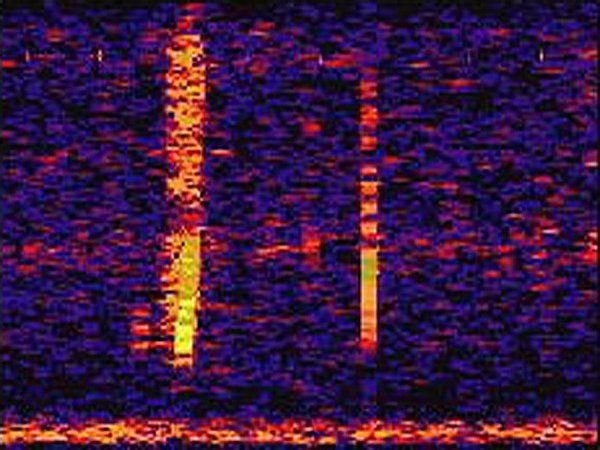
The Bloop: A Mysterious Sound from...
What created this strange sound in Earth's Pacific Ocean? Pictured above is a visual representation of a loud and unusual sound, dubbed a Bloop, captured by deep sea microphones in 1997. In the above graph, time is shown on the horizontal axis, ...

Dust Pillar of the Carina Nebula
Inside the head of this interstellar monster is a star that is slowly destroying it. The monster, on the right, is actually an inanimate pillar of gas and dust that measures over a light year in length. The star, not itself visible through the ...

Planetary Nebula Mz3: The Ant Nebula
Why isn't this ant a big sphere? Planetary nebula Mz3 is being cast off by a star similar to our Sun that is, surely, round. Why then would the gas that is streaming away create an ant-shaped nebula that is distinctly not round? Clues might ...

NGC 1055: Galaxy in a Box
Big, beautiful spiral galaxy NGC 1055 is a dominant member of a small galaxy group a mere 60 million light-years away toward the intimidating constellation Cetus. Seen edge-on, the island universe spans about 100,000 light-years, similar in size ...

SDO: The Extreme Ultraviolet Sun
Don't panic, the Sun has not gone wild. But this wild-looking portrait of the nearest star to planet Earth was made on March 30th by the recently launched Solar Dynamics Observatory (SDO). Shown in false-color, the composite view covers extreme ...

Venus, Mercury, and Moon
rlier this month, Venus and Mercury climbed into the western twilight, entertaining skygazers around planet Earth in a lovely conjunction of evening stars. Combining 8 images spanning April 4 through April 15, this composite tracks their progress ...
ISS
Buy us a coffee!

