
McNaught jest teraz najjaśniejszą...
The brightest comet in decades is unexpectedly now visible. The most optimistic predictions have Comet McNaught (C/2006 P1) shortly becoming one of the brightest comets of the past century. For the next few days, its short tail and bright coma ...

Wielki Chochlik
Do you see it? This common question frequently precedes the rediscovery of one of the most commonly recognized configurations of stars on the northern sky: the Big Dipper. This grouping of stars is one of the few things that has likely been ...
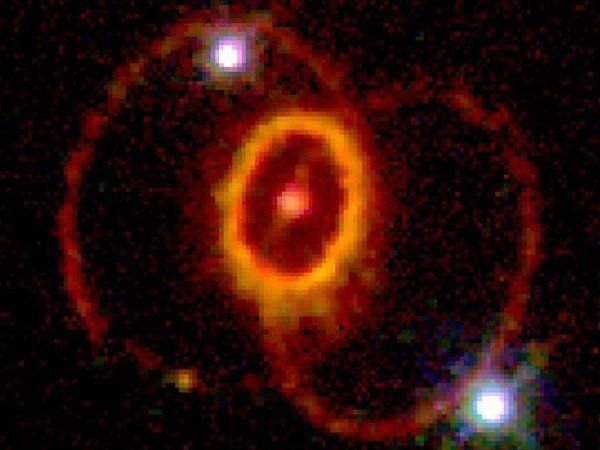
Tajemnicze pierścienie supernowej 1987A
What's causing those odd rings in supernova 1987A? In 1987, the brightest supernova in recent history occurred in the Large Magellanic Clouds. At the center of the picture is an object central to the remains of the violent stellar explosion. ...

Głębokie Pole Oriona
Adrift 1,500 light-years away in one of the night sky's most recognizable constellations, the glowing Orion Nebula and the dark Horsehead Nebula are contrasting cosmic vistas. But even fainter filaments of glowing gas are easily traced throughout ...

Kometa McNaught zmierza w kierunku...
rly morning risers with a clear and unobstructed eastern horizon can enjoy the sight of Comet McNaught (C/2006 P1) in dawn skies over the next few days. Discovered in August by R. H. McNaught (Siding Spring Survey) the comet has grown bright ...

Cygnus środkowy
Supergiant star Gamma Cygni lies at the center of the Northern Cross, famous asterism in the constellation Cygnus the Swan. Known by the proper name Sadr, the bright star also lies at the center of this gorgeous skyscape, featuring a complex of ...

Dwadzieścia pełnych księżyców
In celebration of tonight's Full Moon, the first of 2007, consider this grid of twenty Full Moons. From upper left to lower right, the images represent every lunation from May 2005 through December 2006. The consecutive Full Moons are all shown ...

Światło z pierwszych gwiazd
What were the first stars like? No one is yet sure. Our Sun is not a first-generation star. It is not even second generation. The first stars to appear in the universe likely came and went about 13 billion years ago. However, deep observations ...

NGC 6960: Mgławica "Miotła...
Ten thousand years ago, before the dawn of recorded human history, a new light must suddenly have appeared in the night sky and faded after a few weeks. Today we know this light was an exploding star and record the colorful expanding cloud as ...

Rok pozaziemskich fontann i przepływów
The past year was extraordinary for the discovery of extraterrestrial fountains and flows -- some offering new potential in the search for liquid water and the origin of life beyond planet Earth.. Increased evidence was uncovered that fountains ...
