
Dekada Opportunity na Marsie
On January 25 (UT) 2004, the Opportunity rover fell to Mars, making today the 10th anniversary of its landing. After more than 3,500 sols (Mars solar days) the golf cart-sized robot from Earth is still actively exploring the Red Planet, though ...

Jasna supernowa w M82
Astronomers really don't find supernovae by looking for the arrows. But in this image taken January 23rd, an arrow does point to an exciting, new supernova, now cataloged as SN 2014J, in nearby bright galaxy M82. Located near the Big Dipper in ...

Gromada podwójna w Perseuszu
This lovely starfield spans some seven full moons (about 3.5 degrees) across the heroic northern constellation of Perseus. Just right of center it holds the famous pair of open or galactic star clusters, h and Chi Persei. Also cataloged as NGC ...

The Upper Michigan Blizzard of 1938
Yes, but can your blizzard do this? In Upper Michigan's Storm of the Century in 1938, some snow drifts reached the level of utility poles. Nearly a meter of new and unexpected snow fell over two days in a storm that started 76 years ago tomorrow. ...

Mikroksiężyc nad Superksiężycem
Did you see the big, bright, beautiful Full Moon last Wednesday night? That was actually a Micro Moon! On that night, the smallest Full Moon of 2014 reached its full phase only a few hours from lunar apogee, the time of its the most distant point ...

Akustyczne oscylacje barionowe z...
How large do things appear when far away? When peering across the universe, the answer can actually tell us about its average gravitational history and hence its composition. Toward this goal, the Baryon Oscillation Spectroscopic Survey (BOSS) ...

Galaktyki spiralne w zderzeniu
Billions of years from now, only one of these two galaxies will remain. Until then, spiral galaxies NGC 2207 and IC 2163 will slowly pull each other apart, creating tides of matter, sheets of shocked gas, lanes of dark dust, bursts of star ...

Pełnia Księżyca Apogeum
This big, bright, beautiful Full Moon rose over Lick Observatory Wednesday night. Traditionally a full moon in January might be called the Wolf Moon. But this moon reached its full phase on January 16, 4:54 UT, within about 2 hours of apogee, the ...
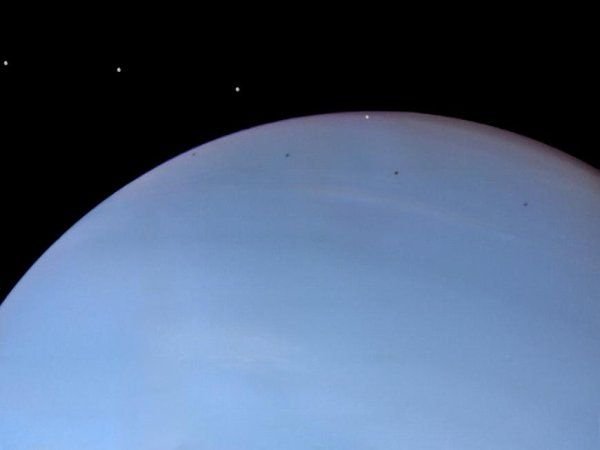
Despina, Księżyc Neptuna
Despina is a tiny moon of Neptune. A mere 148 kilometers across, diminutive Despina was discovered in 1989, in images from the Voyager 2 spacecraft taken during its encounter with the solar system's most distant gas giant planet. But looking ...

Orion Spitzera
Few cosmic vistas excite the imagination like the Orion Nebula, an immense stellar nursery some 1,500 light-years away. This stunning false-color view spans about 40 light-years across the region, constructed using infrared data from the Spitzer ...

