
Zorza październikowa na preriowym niebie
Wind and spaceweather are transformed in this haunting night skyscape. The prairie windmill and colorful auroral display were captured on October 1, from central South Dakota, USA, as a good season for aurora hunters came with longer autumn ...

Najgęstsza Galaktyka
The bright core and outer reaches of giant elliptical galaxy M60 (NGC 4649) loom large at the upper left of this sharp close-up from the Hubble Space Telescope. Some 54 million light-years away and 120,000 light-years across, M60 is one of the ...

M106 z bliska
Close to the Great Bear (Ursa Major) and surrounded by the stars of the Hunting Dogs (Canes Venatici), this celestial wonder was discovered in 1781 by the metric French astronomer Pierre Mechain. Later, it was added to the catalog of his friend ...

Wszystkie kolory słońca
It is still not known why the Sun's light is missing some colors. Here are all the visible colors of the Sun, produced by passing the Sun's light through a prism-like device. The spectrum was created at the McMath-Pierce Solar Observatory and ...

Filamenty pozostałości po supernowej...
The explosion is over but the consequences continue. About eleven thousand years ago a star in the constellation of Vela could be seen to explode, creating a strange point of light briefly visible to humans living near the beginning of recorded ...

Tajemnicze zielone plamy na niebie
What is it? Some surely natural phenomenon has appeared in a video that, so far, has defied clear identification. The above time-lapse video was made to record Perseid meteors above Hopewell Rocks in New Brunswick, Canada late this summer. The ...

Wróżka z Mgławicy Orła
The dust sculptures of the Eagle Nebula are evaporating. As powerful starlight whittles away these cool cosmic mountains, the statuesque pillars that remain might be imagined as mythical beasts. Pictured above is one of several striking dust ...
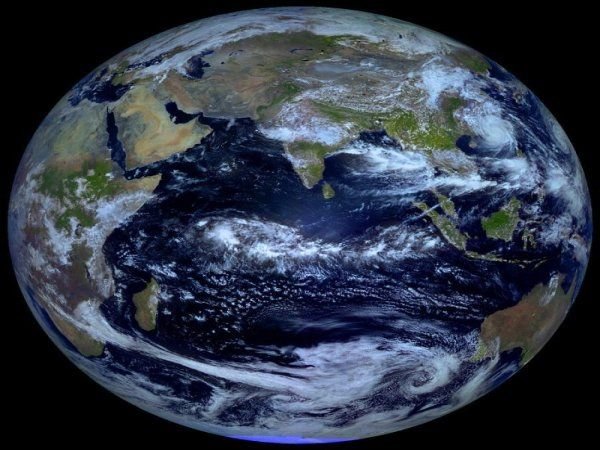
Równonoc ziemska
From a geostationary orbit 36,000 kilometers above the equator, Russian meteorological satellite Elektro-L takes high-resolution images of our fair planet every 30 minutes. But only twice a year, during an Equinox, can it capture an image like ...

Andromeda na skałach
How far can you see? The Andromeda Galaxy 2.5 million light years away is the most distant object easily seen by the unaided eye. Other apparent denizens of the night sky, stars, clusters, and nebulae, typically range from a few hundred to a few ...

M31 kontra M33
Separated by about 14 degrees (28 Full Moons) in planet Earth's sky, spiral galaxies M31, left, and M33 are both large members of the Local Group, along with our own Milky Way galaxy. This wide-angle, telescopic mosaic captures colorful details ...

