
Fly Me to the Moons
Sometimes the Moon is a busy direction. Last week, for example, our very Moon passed in front of the planet Jupiter. While capturing this unusual spectacle from New South Wales, Australia, a quick-thinking astrophotographer realized that a nearby ...
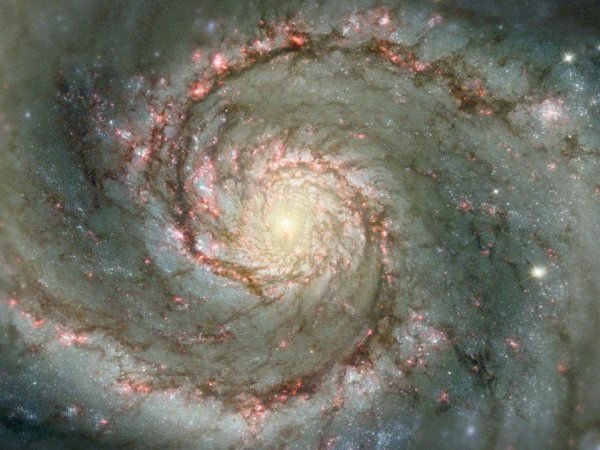
M51: Galaktyka z wirem w pyle i...
The Whirlpool Galaxy is a classic spiral galaxy. At only 30 million light years distant and fully 60 thousand light years across, M51, also known as NGC 5194, is one of the brightest and most picturesque galaxies on the sky. The above image is ...

Błysk Meteoru Czelabińskiego
A meteoroid fell to Earth on February 15, streaking some 20 to 30 kilometers above the city of Chelyabinsk, Russia at 9:20am local time. Initially traveling at about 20 kilometers per second, its explosive deceleration after impact with the lower ...

Curiosity Self-Portrait Panorama
This remarkable self-portrait of NASA's Mars Curiosity Rover includes a sweeping panoramic view of its current location in the Yellowknife Bay region of the Red Planet's Gale Crater. The rover's flat, rocky perch, known as "John Klein", served as ...

Traktor grawitacyjny
How would you change the course of an Earth-threatening asteroid? One possibility - a massive spacecraft that uses gravity as a towline - is illustrated in this artist's vision of a gravitational tractor in action. In the hypothetical scenario ...

Sześciokąt i pierścienie Saturna
Why would clouds form a hexagon on Saturn? Nobody is sure. Originally discovered during the Voyager flybys of Saturn in the 1980s, nobody has ever seen anything like it anywhere else in the Solar System. If Saturn's South Pole wasn't strange ...

Merkury na horyzoncie
Have you ever seen the planet Mercury? Because Mercury orbits so close to the Sun, it never wanders far from the Sun in Earth's sky. If trailing the Sun, Mercury will be visible low on the horizon for only a short while after sunset. If leading ...

Wielki rosyjski meteor z 2013 r.
What in heaven's blazes is that? Thousands of people living near the Ural Mountains in Russia saw last Friday morning one of the more spectacular meteors of modern times streak across the sky. Forceful sound waves arrived at the ground minutes ...

Asteroida 2012 DA14 mija Ziemię
There it goes. That small spot moving in front of background stars in the above video is a potentially dangerous asteroid passing above the Earth's atmosphere. This past Friday, the 50-meter wide asteroid 2012 DA14 just missed the Earth, passing ...

Sweeping Through Southern Skies
For now, Comet Lemmon (C/2012 F6), and Comet PanSTARRS (C/2011 L4) are sweeping through southern skies. Lemmon's lime green coma and thin tail are near the left edge of this telephoto scene, a single frame from a timelapse video (vimeo here) ...
