
Gromada otwarta M25
Many stars like our Sun were formed in open clusters. The above pictured open cluster, M25, contains thousands of stars and is about two thousand light years distant. The stars in this cluster all formed together about 90 million years ago. The ...

D. rad Bacteria: Kandydaci na...
These bacteria could survive on another planet. In an Earth lab, Deinococcus radiodurans (D. rad) survive extreme levels of radiation, extreme temperatures, dehydration, and exposure to genotoxic chemicals. Amazingly, they even have the ability ...

Grupa Galaktyk NGC 7771
Slide your cursor over the image to identify three members of this intriguing gathering of galaxies. Known as the NGC 7771 Group, they lie almost 200 million light-years away toward the high flying constellation Pegasus. The largest galaxy, ...

NGC 7822 w Cefeuszu
Pillars of gas, dust, and young, hot stars fill the center of NGC 7822. At the edge of a giant molecular cloud toward the northern constellation Cepheus, the glowing star forming region lies about 3,000 light-years away. Within the nebula, bright ...

Ciemne niebo nad Parkiem Narodowym...
Scroll right to take in the view from the highest summit in the contiguous USA. The above 360-degree digitally stitched panorama, taken in mid-July, shows the view from 4,400-meter high Mt. Whitney in Sequoia National Park, California. In the ...
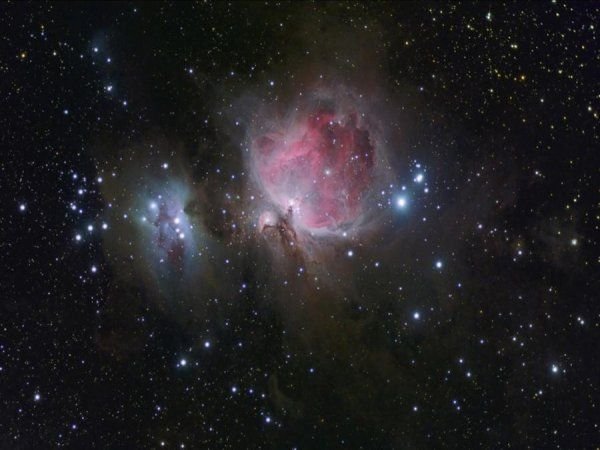
Klasyczne Mgławice Oriona
The Great Nebula in Orion, also known as M42, is one of the most famous nebulae in the sky. The star forming region's glowing gas clouds and hot young stars are near the center of this colorful deep sky image that includes the smaller nebula M43 ...

Równonoc na Saturnie
What would Saturn's rings look like if the ring plane pointed directly at the Sun? That situation occurred earlier this month when equinox occurred on Saturn. Since the Earth is nearly in the same direction as the Sun from Saturn, the rings ...

Chmury Morning Glory nad Australią
What causes these long, strange clouds? No one is sure. A rare type of cloud known as a Morning Glory cloud can stretch 1,000 kilometers long and occur at altitudes up to two kilometers high. Although similar roll clouds have been seen at ...

Olbrzymia gromada zgina się i pęka...
What are those strange blue objects? Many of the brightest blue images are of a single, unusual, beaded, blue, ring-like galaxy which just happens to line-up behind a giant cluster of galaxies. Cluster galaxies here typically appear yellow and ...

Mgławica Dziąsło
Named for Australian astronomer Colin Stanley Gum (1924-1960), The Gum Nebula is so large and close it is actually hard to see. In fact, we are only about 450 light-years from the front edge and 1,500 light-years from the back edge of this cosmic ...
