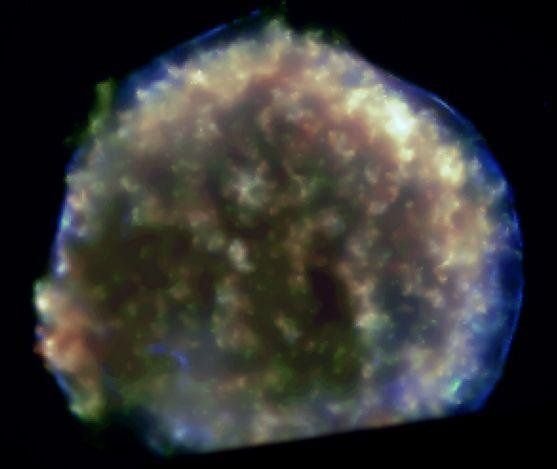
Promienie X z pozostałości po...
In 1572, Danish astronomer Tycho Brahe recorded the sudden appearance of a bright new star in the constellation Cassiopeia. The new star faded from view over a period of months and is believed to have been a supernova, one of the last stellar ...

Fazy Wenus
Venus is currently falling out of the western evening sky. Second planet from the Sun and third brightest celestial object after the Sun and Moon, Venus has been appreciated by casual sky gazers as a brilliant beacon above the horizon after ...

Sharpless 140
Three young, massive stars will eventually emerge from this natal cloud of dust and gas, but their presence is already revealed in this false-color image from the Spitzer Space Telescope. The picture offers a penetrating infrared view of an ...

Krater mózgowy na Marsie
What caused this unusual looking crater floor on Mars? Appearing at first glance to resemble the human brain, the natural phenomena that created the unusual texture on the floor of this Martian impact crater are currently under investigation. ...

Kometa NEAT (Q4) nad Indian Cove
Comet NEAT (Q4) was quite photogenic earlier this month. Although the head and part of the tails of Comet C/2001 Q4 (NEAT) were visible to the unaided eye, the best views of the colorful tail were revealed only later by cameras able to expose ...

NGC 3372: Wielka Mgławica w Carinie
In one of the brightest parts of the Milky Way lies a nebula where some of the oddest things occur. NGC 3372, known as the Great Nebula in Carina, is home to massive stars and changing nebula. Eta Carina, the most energetic star in the nebula ...

Wenus: Chmurny bliźniak Ziemi
This picture by the Galileo spacecraft shows just how cloudy Venus is. Venus is very similar to Earth in size and mass - and so is sometimes referred to as Earth's sister planet - but Venus has a quite different climate. Venus' thick clouds and ...

Arp 188 i ogon pływowy kijanki
In this stunning vista recorded with the Hubble Space Telescope's Advanced Camera for Surveys, distant galaxies form a dramatic backdrop for disrupted spiral galaxy Arp 188, the Tadpole Galaxy. The cosmic tadpole is a mere 420 million light-years ...

Zubenelgenubi i przyjaciele
Moderately bright Zubenelgenubi is the star just off the upper right hand limb of an eclipsed Moon in this telescopic view from Port Elizabeth, South Africa. Actually the second brightest star in the constellation Libra, Zubenelgenubi is fun to ...
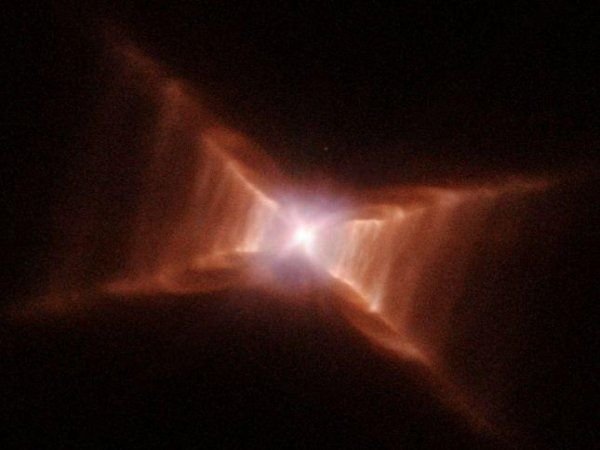
Szczeble czerwonego prostokąta
A distinctive X-shape and ladder-like rungs appear in this Hubble Space Telescope image of the intriguing Red Rectangle Nebula. The dusty cosmic cloud was originally identified as a strong source of infrared radiation and is now believed to ...

