
Masywne gwiazdy 30 Doradus
In the center of star-forming region 30 Doradus lies a huge cluster of the largest, hottest, most massive stars known. These stars and part of the surrounding nebula are captured here in this gorgeous visible-light Hubble Space Telescope image. ...

A Crescent Earth at Midnight
The Earth's northern hemisphere is outlined as a sunlit crescent in this dramatic view from orbit, recorded near local midnight by the Geostationary Operational Environmental Satellite (GOES-8) on June 22, 1996. That date was two days after the ...

Wąż w ciemności
Dark nebulae snake across a gorgeous expanse of stars in this wide-field view toward the pronounceable constellation Ophiucus and the center of our Milky Way Galaxy. In fact, the central S-shape seen here is well known as the Snake Nebula. It is ...
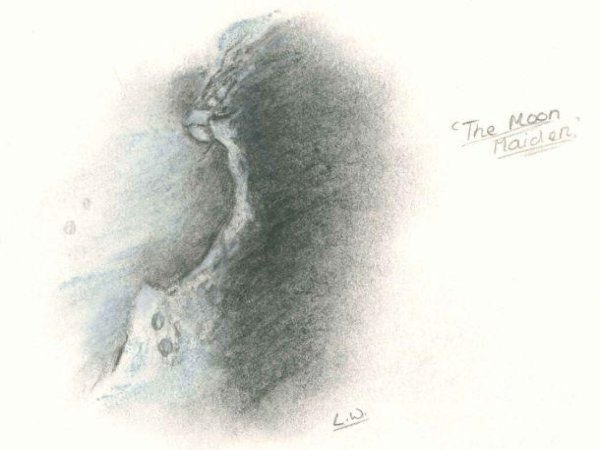
The Moon Maiden
Along the northwestern reaches of the lunar near side, the Sinus Iridum or Bay of Rainbows appropriately lies at the edge of the Moon's smooth, dark Sea of Rains (Mare Imbrium). In this sketch of the lunar surface around the Bay of Rainbows, the ...

Mgławica Bańka z NOAO
It's the bubble versus the cloud. NGC 7635, the Bubble Nebula, is being pushed out by the stellar wind of massive central star BD+602522. Next door, though, lives a giant molecular cloud, visible above to the lower right. At this place in ...

APOD kończy osiem lat
The first APOD appeared eight years ago today, on 1995 June 16. To date, we estimate that APOD has now served over 100 million space-related images. We again thank our readers and NASA for their continued support, but ask that any potentially ...

Chmury Noktilucent
Sometimes it's night on the ground but day in the air. As the Earth rotates to eclipse the Sun, sunset rises up from the ground. Therefore, at sunset on the ground, sunlight still shines on clouds above. Under usual circumstances, a pretty ...
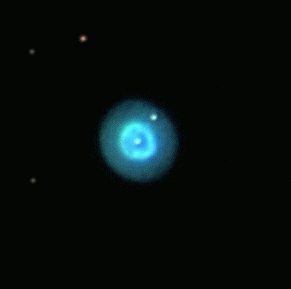
Pokaz mgławic planetarnych
What do the Owl, the Cat's Eye, the Ghost of Jupiter, and Saturn have in common? They're all planetary nebulae of course, glowing gaseous shrouds shed by dying sun-like stars as they run out of nuclear fuel. Beautiful to look at, the symmetric, ...

Neptuna: Still Springtime After All...
In the 1960s spring came to the southern hemisphere of Neptune, the Solar System's outermost gas giant planet. Of course, since Neptune orbits the Sun once every 165 earth-years, it's still springtime for southern Neptune, where each season lasts ...
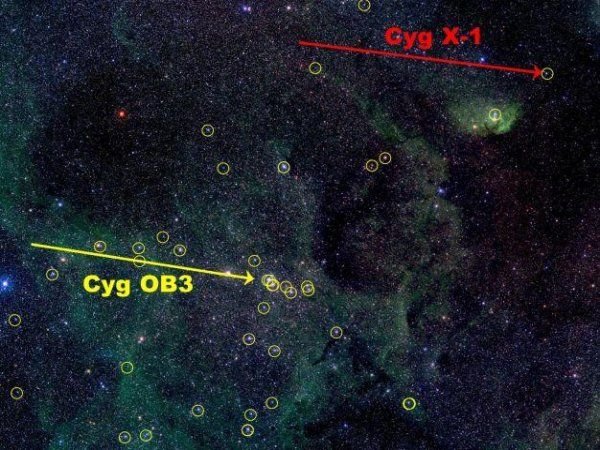
Cyg X-1: Czy czarne dziury mogą...
The formation of a black hole from the collapsing core of a massive star is thought to be heralded by a spectacular supernova explosion. Such an extremely energetic collapse is also a leading explanation for the mysterious cosmic gamma-ray ...
