
Kwestia skupiska pocisków
The matter in galaxy cluster 1E 0657-56, fondly known as the "bullet cluster", is shown in this composite image. A mere 3.4 billion light-years away, the bullet cluster's individual galaxies are seen in the optical image data, but their total ...

Hipoteza piaszczystych strumieni gazu...
What's causing seasonal dark spots on Mars? Every spring, strange dark spots appear near the Martian poles, and then vanish a few months later. These spots typically span 50 meters across and appear fan shaped. Recent observations made with ...

Anioł dymu z flar samolotowych
What type of cloud is that? It is not a naturally occurring one. Looking perhaps a bit like a gigantic owl monster, the cloud pictured above resulted from a series of flares released by an air force jet over the Atlantic Ocean in May. The jet ...
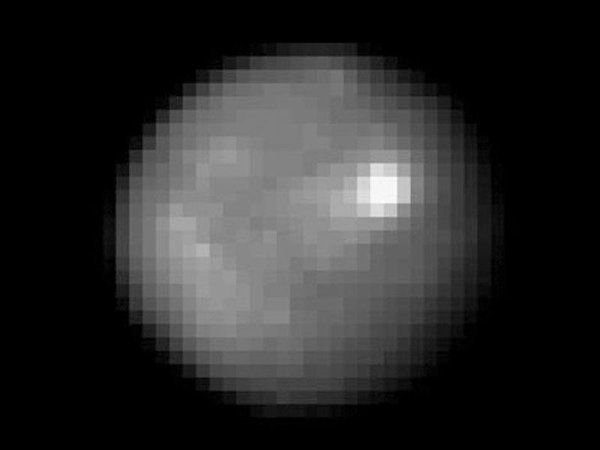
Ceres: Asteroida czy planeta?
Is Ceres an asteroid or a planet? Although a trivial designation to some, the recent suggestion by the Planet Definition Committee of the International Astronomical Union would have Ceres reclassified from asteroid to planet. A change in ...

Mapa asteroidy Vesta
Vesta is a huge rock 500 kilometers across that orbits out past Mars. In 1997, the above map of Vesta created using the Hubble Space Telescope was released showing a rugged surface highlighted by a single crater spanning nearly the entire length ...

Ceci n'est pas un Meteore
To paraphrase Magritte, "This is not a meteor". It's not a picture of a meteor either, but it was taken during last weekend's peak of the Perseid Meteor shower. Skywatching with friends at a cosy beach campsite bathed in moonlight at Treguennec, ...

Orion Spitzera
Few cosmic vistas excite the imagination like the Orion Nebula, an immense stellar nursery some 1,500 light-years away. Also known as M42, the nebula is visible to the unaided eye, but this stunning infrared view from the Spitzer Space Telescope ...

Pył komety nad Kolorado
The rock formation in the foreground of this night view was recorded on August 10, illuminated by light from a waning gibbous Moon. Even though the sky above also scatters the bright moonlight, a brilliant meteor was captured as it flashed across ...

Mgławice Ameryki Północnej i Pelikana
Here are some familiar shapes in unfamiliar locations. This emission nebula on the left is famous partly because it resembles Earth's continent of North America. To the right of the North America Nebula, cataloged as NGC 7000, is a less ...

Promienie kosmiczne
Have you ever been hit by a beam of high energy particles from above? Surely you have -- it happens all of the time. Showers of high energy particles occur when energetic cosmic rays strike the top of the Earth's atmosphere. Cosmic rays were ...

